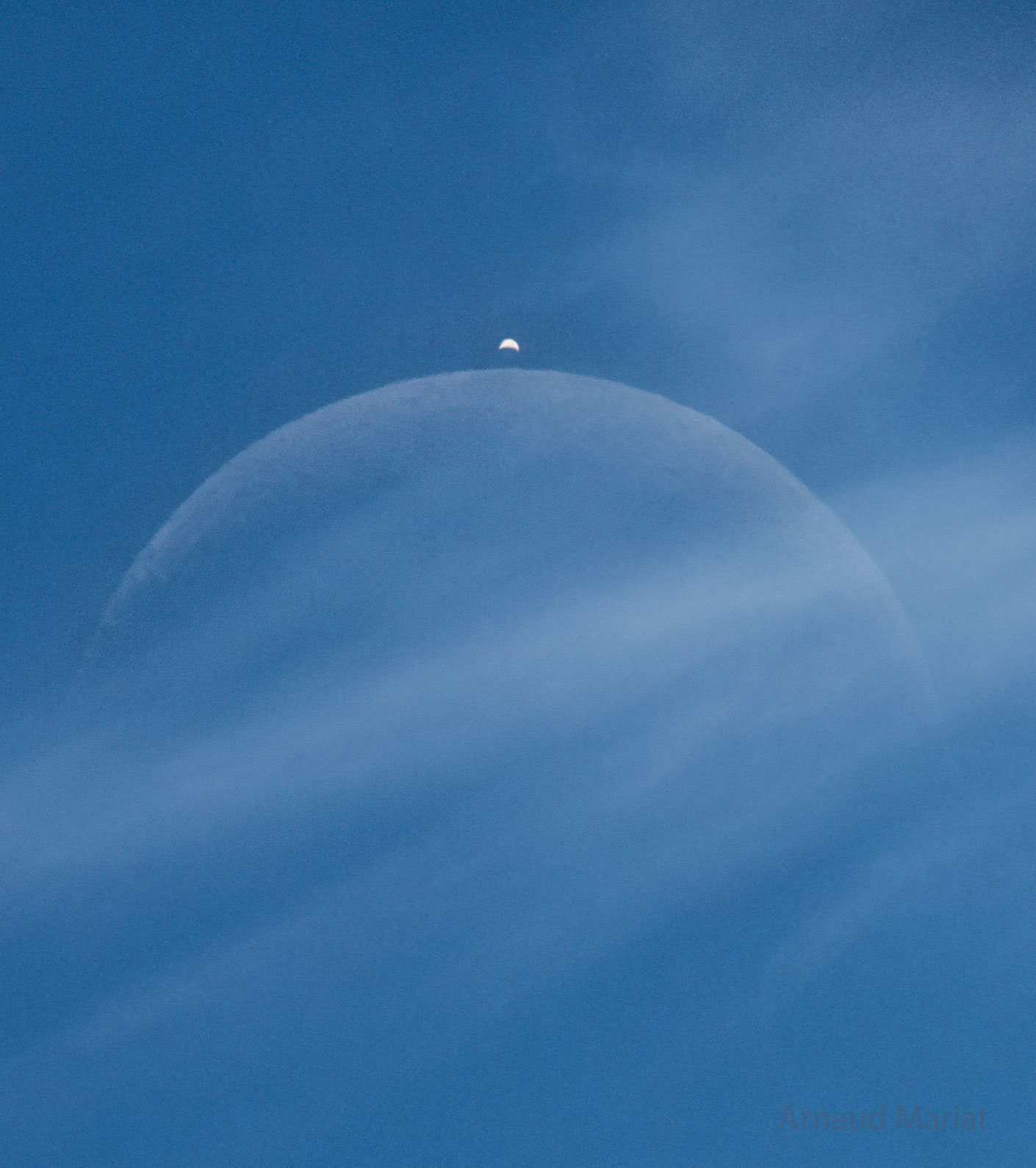


There was something behind the clouds. Upon close inspection, it was the Moon, which was hard to see yesterday around noon above the small village of Cessy, France. But soon, it was not only the Moon. As expected, a bright dot suddenly appeared from behind the Moon -- the planet Venus far in the distance. Captured in the single featured exposure, both appeared to show a crescent phase. The Moon's crescent was quite slight -- with only about 10 percent of its face illuminated by the Sun. In contrast, Venus's crescent was more full -- showing about 25 percent illumination. Venus appeared brighter because it is nearer the Sun and because its clouds are more reflective than the dark lunar surface. An occultation of Venus by the Moon is visible to only about 10 percent of the Earth, but in yesterday's event even most of that was experiencing daytime. APOD's main NASA site is moving: From apod.nasa.gov to science.nasa.gov/apod
Estos días hemos tenido problemas con el proveedor de internet, por eso la página web permaneció ina...
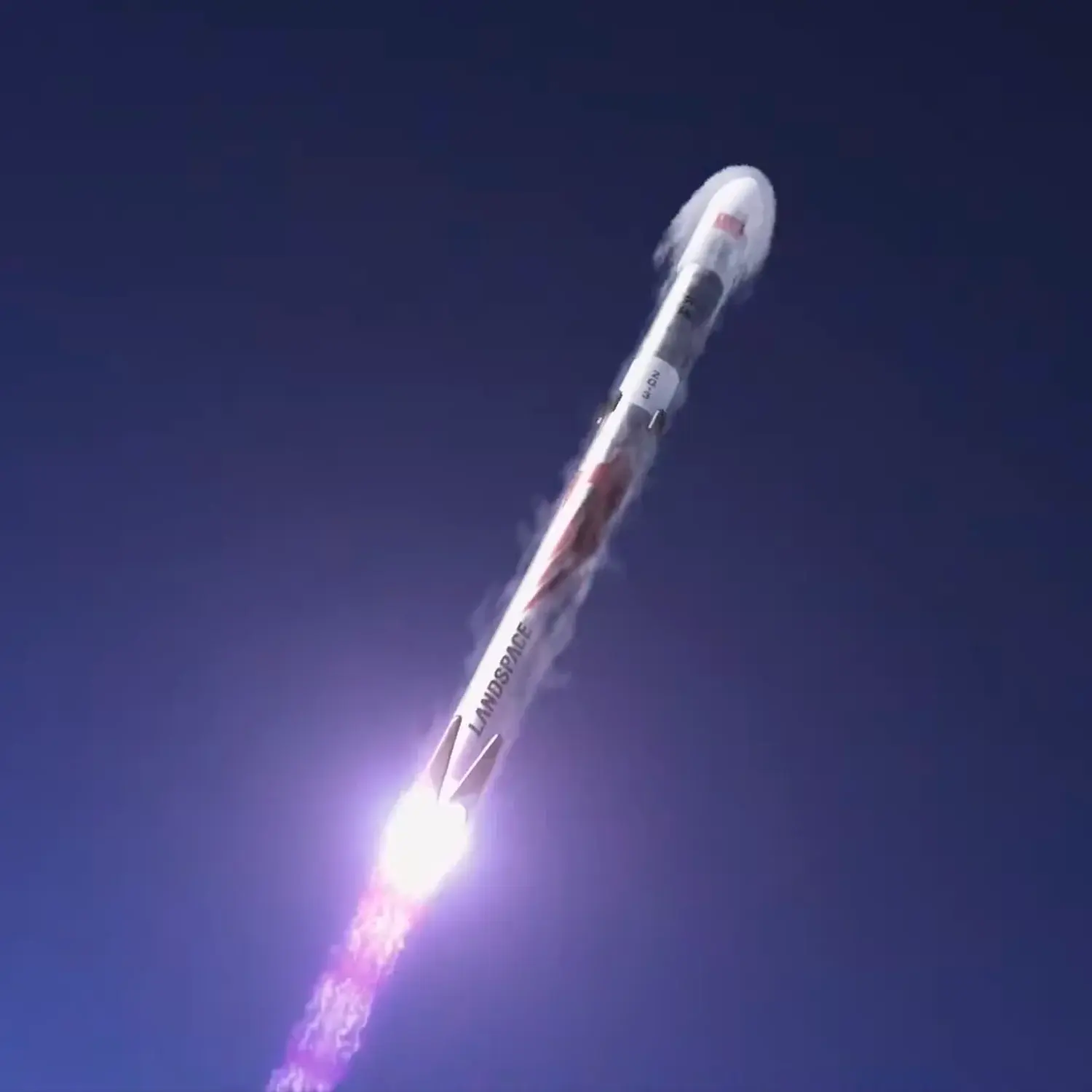
La empresa china LandSpace ha alcanzado un importante hito al completar con éxito una prueba de ence...
En un movimiento histórico, las gigantes europeas Airbus, Leonardo y Thales han anunciado la creac...
Space Force programs are tapping satellite data and AI to get intelligence to military commanders faster The post More satellites watch the battlefield, putting a premium on making sense of the data appeared first on SpaceNews.
Since raising more than $1 billion in a Series F funding round, Iceye has moved rapidly to address growing demand for sovereign space capabilities. In quick succession, the Finnish synthetic […] The post Iceye’s global presence expands to address sovereign demand appeared first on SpaceNews.
Join us for conversations about the tech, policies and business models required to build a functioning in-orbit logistics ecosystem The post Sept. 21: What Comes Next for On-Orbit Servicing? appeared first on SpaceNews.
Download our new mapping of every private space company valued at $1 billion or more. The post Space’s growing billion-dollar club appeared first on SpaceNews.
Australian Earth observation satellite company LatConnect 60 (LC60) has strengthened its position in India with two strategic agreements announced at the Bengaluru Space Expo 2026 on September 7th, spanning satellite […] The post LatConnect 60 Expands India Market Presence for SWIRSAT With NSIL Agreement and GeoSyze Partnership appeared first on SpaceNews.
Leuven, Belgium & Halifax, Canada – 3 September 2026 – European optical payload provider Simera Sense today announced that Canadian space technology company Galaxia has acquired a HyperScape100 hyperspectral imaging […] The post Galaxia Takes Next Step in Earth Observation with purchase of Simera Sense Hyperspectral Imager appeared first on SpaceNews.